
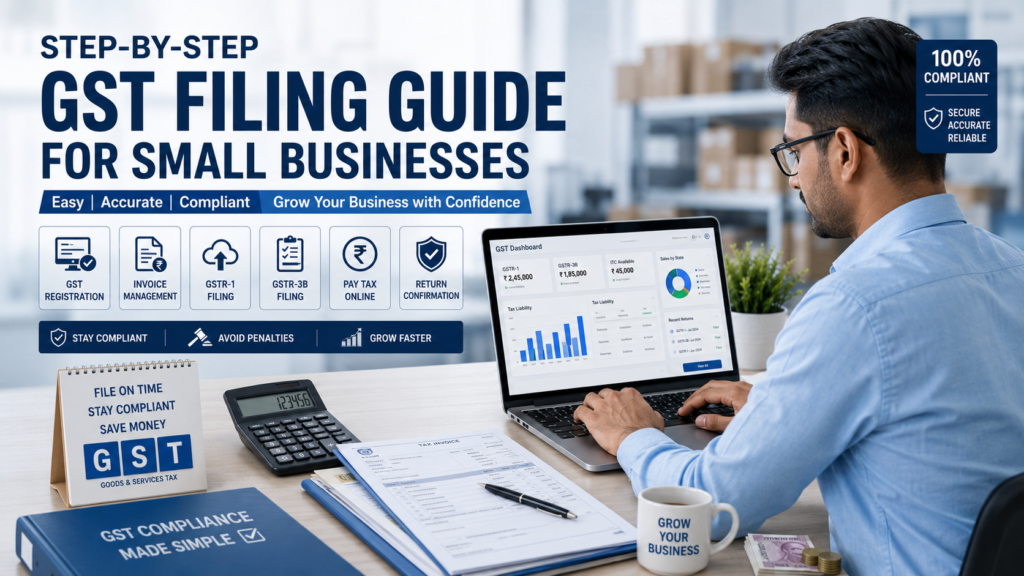
Step-by-Step GST Filing Guide for Small Businesses
Running a small business in India comes with many responsibilities, and tax compliance is one of the most important. A proper GST filing guide can help business owners avoid penalties, save money, and keep operations smooth. Since the introduction of Goods and Services Tax (GST), businesses across India have needed to adapt to digital tax systems and stricter compliance rules.
Whether you are a startup owner, retailer, freelancer, or manufacturer, understanding GST registration India procedures and return filing rules is essential. This detailed guide explains everything small businesses need to know about GST filing, deadlines, and common mistakes to avoid.
Understanding GST in India
What Is GST and Why It Matters
Goods and Services Tax (GST) is a unified indirect tax system introduced in India in 2017. It replaced multiple taxes like VAT, service tax, and excise duty with one simplified structure.
GST applies to the supply of goods and services throughout India. Businesses collect GST from customers and deposit it with the government.
The main goals of GST are:
- Simplify taxation
- Reduce tax evasion
- Improve transparency
- Create a single national market
For SMEs, GST has made interstate trade easier and improved tax credit availability.
Types of GST: CGST, SGST, and IGST
India’s GST system has different components:
| GST Type | Meaning | Applicable On |
|---|---|---|
| CGST | Central GST | Within the same state |
| SGST | State GST | Within the same state |
| IGST | Integrated GST | Interstate transactions |
Understanding these categories helps businesses file returns correctly.
Importance of GST Compliance for SMEs
Benefits of Timely GST Filing
Strong GST compliance for SMEs offers several benefits:
- Avoid penalties and interest
- Maintain business credibility
- Claim Input Tax Credit (ITC)
- Smooth business expansion
- Easier loan approvals
Businesses with proper GST records also find it easier to attract investors and vendors.
Penalties for Non-Compliance
Failure to comply with GST rules can lead to:
- Late fees
- Interest charges
- GSTIN suspension
- Legal notices
- Loss of Input Tax Credit
Even a small filing error can create complications later.
GST Registration India Explained
Who Needs GST Registration
GST registration is mandatory for businesses meeting specific turnover criteria.
You need GST registration if:
- Annual turnover exceeds prescribed limits
- You sell goods interstate
- You operate an e-commerce business
- You are a casual taxable person
- You provide online services
Threshold Limits for Businesses
| Business Type | Threshold Limit |
|---|---|
| Goods Suppliers | ₹40 Lakhs |
| Service Providers | ₹20 Lakhs |
| Special Category States | Lower limits apply |
These limits may change based on government updates.
Documents Required for GST Registration
You generally need:
- PAN card
- Aadhaar card
- Business registration proof
- Address proof
- Bank account details
- Passport-size photographs
Step-by-Step GST Registration Process
Creating a GST Portal Account
The first step in GST registration India is visiting the official GST portal.
You can access the portal here: GST Portal
Create an account using:
- Mobile number
- Email address
- PAN details
You will receive OTP verification for authentication.
Filling the GST REG-01 Form
The GST REG-01 form requires business details such as:
- Legal business name
- Trade name
- Business constitution
- Principal place of business
- Authorized signatory information
Make sure every detail matches official documents.
ARN and GSTIN Explained
After submission:
- You receive an ARN (Application Reference Number)
- Once approved, you get a GSTIN (GST Identification Number)
GSTIN is your unique business tax identity.
GST Filing Guide for Beginners
Types of GST Returns
Different businesses must file different GST returns.
GSTR-1
GSTR-1 contains sales details and outward supplies.
Filed by:
- Monthly filers
- Quarterly filers under QRMP
GSTR-3B
GSTR-3B is a summary return showing:
- Sales
- Purchases
- Tax liability
- ITC claims
It is one of the most important GST returns.
Annual Returns
Businesses also need annual returns like GSTR-9.
These summarize yearly transactions and tax liabilities.
GST Filing Deadlines Every SME Must Know
Monthly Filing Deadlines
| Return | Due Date |
|---|---|
| GSTR-1 | 11th of next month |
| GSTR-3B | 20th of next month |
Quarterly Return Deadlines
Businesses under QRMP usually file quarterly returns.
Due dates vary based on state grouping.
Annual Return Due Dates
Annual returns are generally due by December 31 of the following financial year.
Always verify current deadlines on the official GST portal.
Input Tax Credit (ITC) Explained
How ITC Works
Input Tax Credit allows businesses to reduce tax liability on purchases.
Example:
- GST paid on raw materials = ₹10,000
- GST collected from customers = ₹15,000
- Net payable GST = ₹5,000
This prevents double taxation.
Conditions to Claim ITC
To claim ITC:
- Supplier must upload invoice
- Invoice must be valid
- Goods/services must be received
- GST return must be filed
Incorrect ITC claims are a major compliance risk.
Common GST Filing Mistakes to Avoid
Incorrect Invoice Details
Many SMEs enter incorrect:
- GSTIN numbers
- Invoice dates
- Tax rates
Even tiny errors can block ITC claims.
Missing Filing Deadlines
Late filing leads to:
- ₹50 per day penalties
- Interest charges
- Return filing restrictions
Using reminders and accounting software helps avoid delays.
Claiming Wrong ITC
Businesses sometimes claim ITC on:
- Personal expenses
- Blocked credits
- Unsupported invoices
Always verify eligibility before claiming credits.
Ignoring Reconciliation
Monthly reconciliation ensures:
- Sales match GST returns
- Purchases match vendor uploads
- ITC claims are accurate
Ignoring reconciliation creates long-term tax issues.
Best Practices for GST Compliance for SMEs
Maintain Proper Records
Keep organized records of:
- Sales invoices
- Purchase invoices
- E-way bills
- Credit notes
- Debit notes
Digital storage improves accessibility.
Use GST Accounting Software
Modern software automates:
- Invoice generation
- Tax calculation
- Return preparation
- Error detection
This reduces manual work significantly.
Reconcile Monthly
Monthly reconciliation helps businesses:
- Detect mismatches early
- Avoid notices
- Improve financial accuracy
Consistency is key.
GST Filing Guide for Composition Scheme Businesses
Eligibility for Composition Scheme
Small businesses with lower turnover can opt for the Composition Scheme.
Benefits include:
- Lower tax rates
- Simplified filing
- Reduced compliance burden
However, composition dealers cannot claim ITC.
Returns Under Composition Scheme
Composition taxpayers usually file:
- CMP-08 quarterly
- GSTR-4 annually
These returns are simpler than regular GST filings.
How Technology Simplifies GST Filing
Online GST Portals
The government’s GST portal enables:
- Registration
- Return filing
- Refund applications
- Payment tracking
Digital systems reduce paperwork.
Automation Tools for SMEs
Automation tools help with:
- Invoice matching
- Tax calculations
- Filing reminders
- Compliance reports
This improves accuracy and saves time.
FAQs About GST Filing Guide
1. Is GST registration mandatory for all small businesses?
No. GST registration becomes mandatory only after crossing the prescribed turnover threshold or under certain business conditions.
2. What happens if I miss a GST filing deadline?
Late fees and interest are charged. Continuous non-compliance can also suspend your GST registration.
3. Can I revise a GST return after filing?
GST returns usually cannot be revised directly. Corrections must be adjusted in future returns.
4. What is the penalty for late GST filing?
The standard late fee is ₹50 per day, subject to limits set by the government.
5. How can SMEs improve GST compliance?
SMEs can improve compliance by maintaining records, reconciling monthly, and using GST software.
6. What is the QRMP scheme?
QRMP stands for Quarterly Return Monthly Payment. It allows eligible businesses to file returns quarterly while paying taxes monthly.
Conclusion
A strong understanding of the GST filing guide process helps small businesses stay compliant and financially healthy. From completing GST registration India procedures to meeting deadlines and avoiding common errors, every step matters.
Good GST compliance for SMEs not only prevents penalties but also improves business credibility and operational efficiency. By maintaining accurate records, filing returns on time, and using technology wisely, small businesses can handle GST confidently and focus on growth.
For official GST information and updates, visit the government portal: GST Official Website