
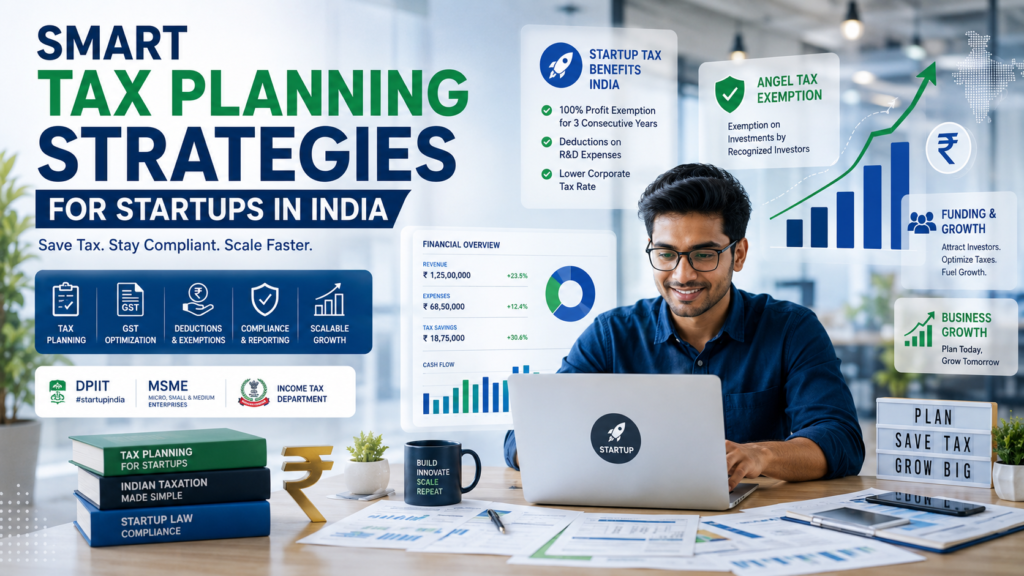
: Smart Tax Planning Strategies for Startups in India can help founders reduce liabilities, maximize startup tax benefits India offers, and understand angel tax exemption rules while staying compliant.
Starting a business in India is exciting, but managing taxes can quickly become overwhelming. From understanding government incentives to handling GST filings and startup exemptions, every founder needs a clear roadmap. Effective tax planning for startups is not just about saving money—it’s about building a financially healthy company from day one.
India’s startup ecosystem has grown rapidly, and the government has introduced several policies to encourage innovation and entrepreneurship. These include tax holidays, angel tax exemption provisions, easier compliance norms, and incentives for eligible startups. However, many founders miss these benefits because they are unaware of the rules or fail to comply properly.
In this comprehensive guide, you’ll learn practical and legal ways to optimize taxes, improve compliance, and unlock valuable startup tax benefits India provides.
Understanding Startup Taxation in India
India’s taxation system for startups includes income tax, GST, TDS, professional tax, and several regulatory filings. Many founders focus only on fundraising and growth while ignoring taxation until notices arrive. That approach can create penalties and financial stress.
Good tax planning for startups helps businesses:
- Reduce unnecessary tax burdens
- Improve cash flow
- Increase investor confidence
- Stay legally compliant
- Avoid penalties and litigation
A startup with proper tax management can use saved funds for hiring, marketing, product development, and expansion.
Why Tax Planning Matters for New Businesses
Tax planning is essential because startups usually operate with limited capital. Every rupee saved through legal deductions and exemptions can be reinvested into growth.
Benefits include:
- Better financial forecasting
- Easier fundraising
- Stronger compliance record
- Reduced risk during due diligence
Investors often examine a startup’s compliance history before investing. Poor tax management can become a major red flag.
Common Tax Challenges Faced by Startups
Startups in India commonly struggle with:
- Delayed GST filings
- Incorrect TDS deductions
- Poor bookkeeping
- Misclassification of expenses
- Lack of awareness about exemptions
These issues can lead to penalties and legal complications later.
Startup Recognition Under DPIIT
The Department for Promotion of Industry and Internal Trade (DPIIT) provides official startup recognition to eligible businesses.
Eligibility Criteria for DPIIT Recognition
To qualify:
- The company must be less than 10 years old
- Annual turnover should not exceed ₹100 crore
- The business must focus on innovation or scalability
Eligible entities include:
- Private Limited Companies
- LLPs
- Registered Partnership Firms
Benefits of DPIIT Registration
DPIIT-recognized startups receive several startup tax benefits India offers, including:
- Tax holiday under Section 80-IAC
- Angel tax exemption
- Easier public procurement norms
- Self-certification under labor laws
- Faster patent processing
You can apply through the official Startup India portal:
Startup Tax Benefits India Offers
India provides several tax incentives specifically designed to support startups.
Section 80-IAC Tax Holiday
Eligible startups can claim a 100% income tax exemption for three consecutive years out of ten years since incorporation.
This helps startups reinvest profits into business growth instead of paying taxes during early stages.
The formula for tax savings can be represented as:
Tax Savings=Profits Eligible for Deduction×Applicable Tax Rate
Conditions Include:
- DPIIT recognition required
- Incorporation after April 1, 2016
- Turnover below prescribed limits
Carry Forward of Losses
Normally, companies lose the ability to carry forward losses if shareholding changes significantly. Startups receive relaxation under Section 79.
This provision is valuable because startups often incur losses during initial years.
Capital Gains Exemptions
Certain capital gains exemptions are available if gains are invested into eligible startup assets or funds.
Benefits include:
- Reduced tax liabilities
- Improved reinvestment opportunities
- Increased liquidity
Angel Tax Exemption Explained
The topic of angel tax exemption is extremely important for startups raising early-stage funding.
What Is Angel Tax?
Angel tax refers to tax imposed when startups issue shares at a premium above fair market value.
Under Section 56(2)(viib), the excess amount could be taxed as income.
For example:
Angel Taxable Amount=Issue Price−Fair Market Value
This provision created problems for startups receiving investments from angel investors.
Eligibility for Angel Tax Exemption
To qualify for angel tax exemption, startups must:
- Obtain DPIIT recognition
- File Form 2 declaration
- Meet investment thresholds
- Ensure investor compliance
Recognized startups are exempt from angel tax on eligible investments.
Important Documentation Requirements
Maintain proper records including:
- Valuation reports
- Investor PAN details
- Share allotment records
- Board resolutions
- Financial statements
Poor documentation can trigger scrutiny notices.
GST Planning for Startups
GST compliance is one of the most important operational responsibilities.
GST Registration Rules
GST registration becomes mandatory if turnover exceeds prescribed limits or interstate supply rules apply.
Businesses dealing in SaaS, ecommerce, or digital services often require registration earlier.
Input Tax Credit Optimization
Input Tax Credit (ITC) allows startups to reduce tax liability on purchases.
Formula:
Net GST Liability=Output GST−Input Tax Credit
Best practices include:
- Collect vendor invoices properly
- Match GSTR filings regularly
- Avoid blocked credits
Avoiding GST Compliance Mistakes
Common errors:
- Late returns
- Incorrect invoice formats
- Missing reconciliations
- Wrong GST rates
Automation software can help reduce errors significantly.
Choosing the Right Business Structure
Your legal structure affects taxation, compliance, and fundraising ability.
Private Limited Company vs LLP
| Feature | Private Limited | LLP |
|---|---|---|
| Funding Friendly | Yes | Limited |
| Compliance | Higher | Moderate |
| Tax Flexibility | Better for scaling | Simpler |
| ESOPs | Allowed | Limited |
Most scalable startups prefer Private Limited Companies because investors favor them.
Tax Implications of Different Structures
Private companies face corporate tax rates, while LLPs have pass-through characteristics in some situations.
Choosing the wrong structure may increase long-term tax burden.
Expense Management and Deductions
Expense optimization is a key part of tax planning for startups.
Deductible Startup Expenses
Allowable deductions generally include:
- Rent
- Salaries
- Marketing costs
- Software subscriptions
- Legal fees
- Internet and cloud services
Maintain invoices and payment proofs carefully.
Employee Salary and ESOP Tax Planning
Employee Stock Ownership Plans (ESOPs) help startups attract talent.
However, ESOP taxation involves:
- Perquisite taxation
- Capital gains tax
- Deferred taxation rules for eligible startups
Proper structuring can improve employee retention and tax efficiency.
Compliance Essentials Every Startup Must Follow
Ignoring compliance can destroy startup credibility.
ROC Filings
Companies must file:
- Annual returns
- Financial statements
- Director disclosures
Non-compliance can result in heavy penalties.
TDS Compliance
Tax Deducted at Source applies to:
- Salaries
- Contractor payments
- Professional fees
- Rent
Late TDS deposits attract interest and penalties.
Accounting and Audit Requirements
Maintain accurate books through:
- Accounting software
- Monthly reconciliations
- Internal audits
Professional accountants help avoid costly mistakes.
International Tax Considerations for Startups
Many Indian startups serve global customers or receive overseas investments.
Transfer Pricing Rules
Transactions with foreign entities must comply with arm’s length pricing principles.
Improper pricing may trigger tax adjustments.
Taxation for Foreign Investments
Foreign funding may involve:
- FEMA compliance
- Share valuation norms
- Withholding taxes
- Double taxation treaties
Professional advisory support becomes crucial in cross-border transactions.
Funding and Tax Planning
Fundraising and taxation are deeply connected.
Venture Capital Tax Implications
VC investments can affect:
- Share dilution
- Valuation reporting
- Capital gains taxation
Founders should structure rounds carefully.
Convertible Notes and Taxation
Convertible instruments offer flexibility but require proper documentation and valuation methods.
Tax implications depend on conversion timing and investor classification.
Tax Saving Strategies for Tech Startups
Technology startups may qualify for additional incentives.
R&D Deductions
Research-oriented companies can benefit from deductions related to innovation expenses.
Areas include:
- Product development
- Software research
- Prototype creation
Software Export Benefits
Exporting software services may provide GST-related advantages and foreign exchange benefits.
Export-oriented startups should maintain proper export documentation.
Common Tax Mistakes Startups Should Avoid
Avoid these frequent errors:
- Mixing personal and business expenses
- Ignoring GST notices
- Poor recordkeeping
- Missing tax deadlines
- Improper valuation reports
- Delayed statutory filings
- Ignoring professional advice
A proactive approach prevents future complications.
Future Tax Trends Impacting Indian Startups
India’s startup ecosystem continues evolving rapidly.
Emerging trends include:
- Increased digital compliance
- AI-driven tax assessments
- Simplified startup regulations
- Enhanced scrutiny of cross-border transactions
- Improved online filing systems
Founders who stay updated gain a competitive advantage.
Frequently Asked Questions
1. What is the biggest tax benefit available for startups in India?
The Section 80-IAC tax holiday is among the most valuable incentives, allowing eligible startups to claim 100% income tax exemption for three years.
2. Who qualifies for angel tax exemption?
DPIIT-recognized startups meeting prescribed conditions can apply for angel tax exemption.
3. Is GST mandatory for startups?
GST registration depends on turnover, business type, and interstate operations.
4. Can startups carry forward losses?
Yes, eligible startups receive relaxation under Section 79 for carrying forward losses.
5. Why is DPIIT recognition important?
It unlocks several startup tax benefits India offers, including tax exemptions and easier compliance.
6. Should startups hire tax professionals early?
Yes. Early professional guidance helps avoid costly mistakes and improves compliance management.
Conclusion
Smart taxation strategies can dramatically improve a startup’s financial health. Effective tax planning for startups involves much more than reducing taxes—it supports long-term growth, investor confidence, and operational stability.
By leveraging available startup tax benefits India provides, understanding angel tax exemption rules, and maintaining strong compliance practices, founders can preserve capital and focus on scaling their businesses successfully.
The key is to start early, maintain proper records, and seek professional advice whenever necessary. A startup that manages taxes intelligently gains a major competitive edge in India’s rapidly growing entrepreneurial ecosystem.